

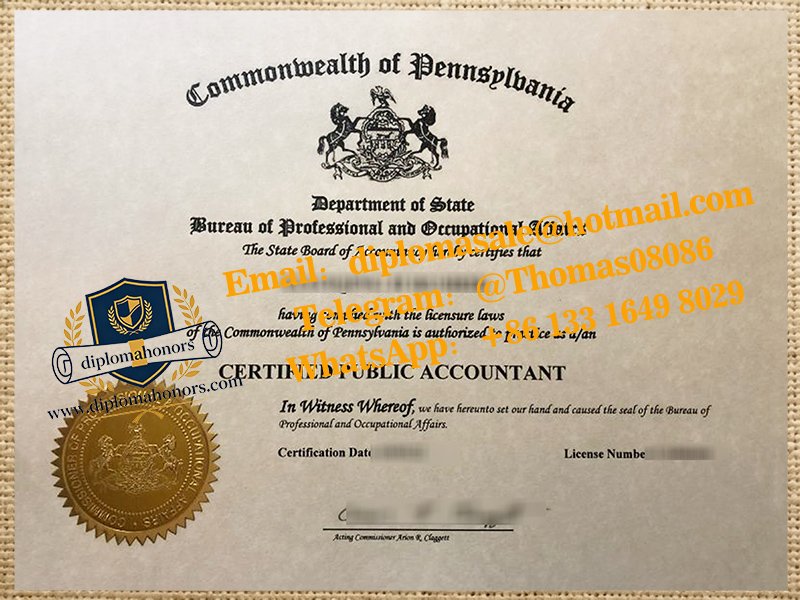
A Pennsylvania CPA certificate is a valuable, state-recognized professional credential that validates advanced accounting skills, ethical standards, and practical financial expertise for accounting practitioners. Governed by the Pennsylvania State Board of Accountancy, this certification serves as a trusted benchmark for businesses, accounting firms, and financial institutions across the Keystone State and the entire United States. For accounting students and junior finance professionals, earning a Pennsylvania CPA certificate is a transformative step to build credibility, unlock stable high-level roles, and stand out in the competitive regional financial job market.
Obtaining a legitimate Pennsylvania CPA certificate requires candidates to complete standardized education, examination, and practical experience criteria updated for 2026. Unlike other states, Pennsylvania offers flexible licensing pathways tailored to applicants’ academic backgrounds. All candidates must hold an accredited bachelor’s degree and complete a total of 150 semester credit hours, including a minimum of 24 semester hours in core accounting courses covering financial accounting, auditing, taxation, and managerial accounting. This targeted academic requirement ensures candidates master fundamental and advanced accounting principles for professional practice.
Pennsylvania CPA Certificate: Licensing Requirements and Career Prospects 2026
The Uniform CPA Examination is the universal core assessment for all Pennsylvania CPA license applicants. The four-section exam evaluates auditing and attestation, business environment and concepts, financial reporting, and regulation. Candidates can take exam sections individually and must pass all parts with a score above the national standard to qualify for licensure. While Pennsylvania allows students to sit for the exam with 120 credit hours, full certification requires the complete 150-credit academic curriculum plus verified work experience.
Professional experience verification is a unique and critical requirement for Pennsylvania CPA licensing. Qualified applicants need to complete 1,600 hours of supervised professional experience, equivalent to one full year of work. This practical experience must be verified by an actively licensed CPA and can be completed in public accounting firms, government financial departments, corporate finance teams, or academic accounting roles. Acceptable work includes auditing, tax preparation, financial consulting, and financial statement compilation, ensuring certificate holders possess real-world problem-solving capabilities.
Holding a Pennsylvania CPA license brings remarkable career and professional advantages. Firstly, it significantly broadens local and national job opportunities. Top regional accounting firms, Pennsylvania-based corporations, and public finance departments prioritize CPA-certified candidates for senior accounting, tax advisory, and audit management roles. The credential also supports cross-state practice with streamlined reciprocity rules across most U.S. states.
Secondly, the certificate delivers competitive salary benefits and long-term career growth. Industry reports show Pennsylvania CPA holders earn substantially higher wages than uncertified accounting professionals, with faster promotion paths to leadership positions. Additionally, license holders must complete 80 hours of continuing professional education every two years, keeping their knowledge updated with evolving tax laws, accounting regulations, and financial compliance standards.
In summary, the Pennsylvania CPA certificate is a credible, high-value credential for anyone pursuing a long-term accounting and finance career in Pennsylvania. Though the licensing process demands dedicated academic effort and practical training, its professional recognition, job stability, and salary advantages make it a worthwhile investment for ambitious finance practitioners in 2026 and beyond.